
This project is protected. Please enter a password.


NeuroMatch: V0-V1 Product launch


Seizure-diagnostic platform

Launch an FDA-compliant EEG analysis platform supporting Neurologists diagnosing seizures.

Role:Founding Design Lead

Scope:Research, Design, Discipline lead

Time:15 months

Team:PM, Clinical researchers, ML engineers

Ownership:

Defined the UX strategy for full product ecosystem.

Led end-to-end product research with neurologists.

Built the Figma design system from scratch.

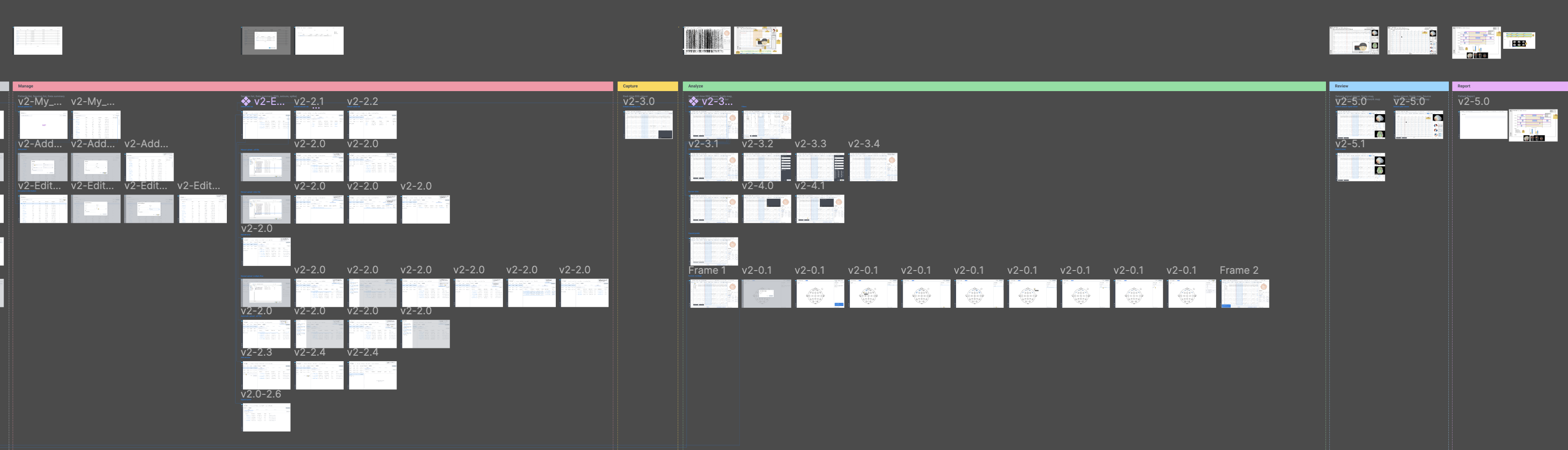
Established product information architecture.

Delivered critical clinical workflows to engineering.

Presented regular updates to Founder.

Partnered with Product & Eng leadership to ensure FDA readiness.

Impact:

V0 to V1 FDA-ready platform & design system
Strategic problem

Clinicians rely on EEG (Electroencephalogram) data to make crucial decisions about neurological abnormalities. HEEG tools are fragmented across outdated systems, requiring clinicians to navigate multiple interfaces for a single patient. Through ML-reading interface, detection tools, and trend models, NeuroMatch aims to help doctors analyze patient data in order to provide faster diagnoses with greater accuracy.

Business goals

  • Launch a fully revised version (v1) of the beta product (v0): a unified, clinically-legible, ML-enhanced platform capable of improving diagnostic accuracy and can be accessed remotely
  • Achieve FDA approval for initial clinical adoption in hospitals
  • Product goals

    Launch NeuroMatch as a competitive ML-powered platform that expedites EEG-lifecycle workflows while ensuring regulatory safety and hospital IT compatibility.

    Research


    Establishing foundational research practices to define an MVP

    Prior to my position, the LVIS team had minimal research practices informing strategy and validation. When I joined, I immediately established a commitment to regular, structured user interviews between our team (the PM and the Clinical Research lead) and Physician consultants.

    Goals of our research program:
  • Establish a baseline and refined understanding of primary users and their pain points
  • Deliver business strategy and roadmap outlining the most critical features for launch
  • Build a relationship with potential customers to get iterative, directional feedback on solutions
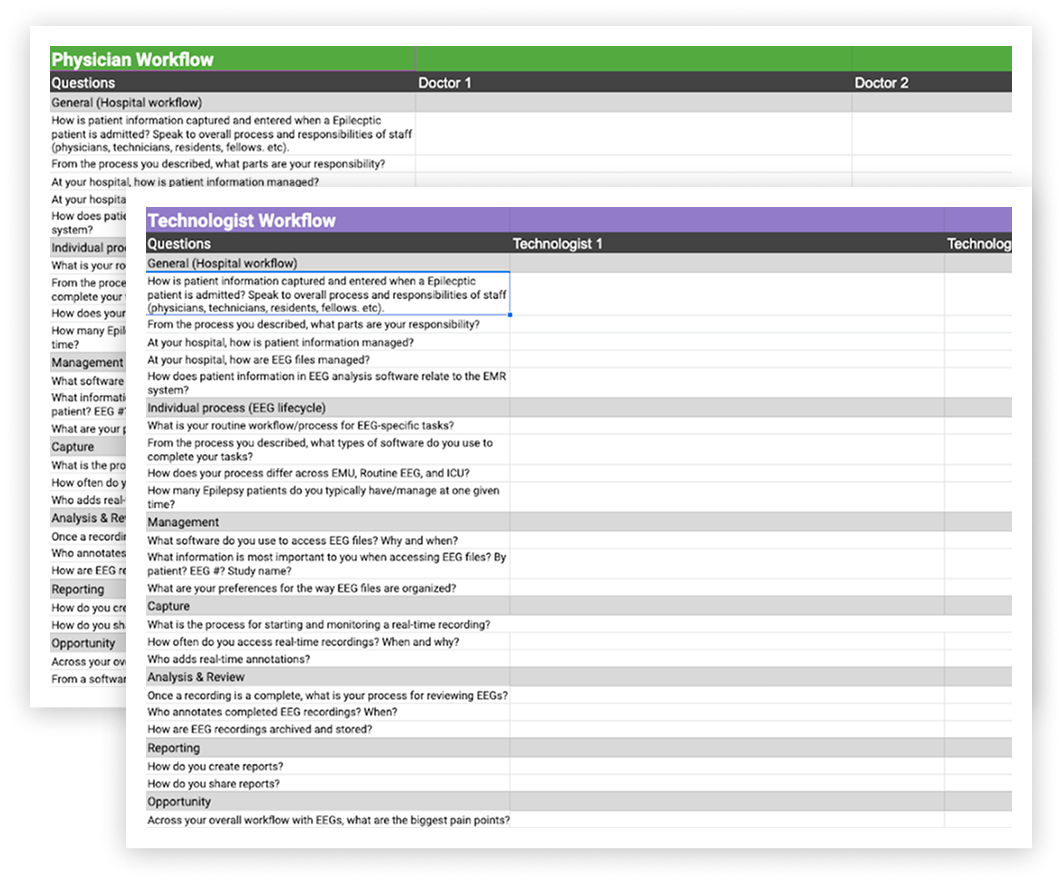
  • Over 3 weeks, I conducted three 60-minute interviews with 10 interviewees from 3 different hospitals. From this round, we defined role-specific workflows spanning the EEG lifecycle of patient intake and seizure diagnosis.

    Workflows & pain points

    In my role, I owned interview guides, interview facilitation, and synthesis of findings, which I'd present back to Engineering, team leads, and Founder.

    Competitor analysis

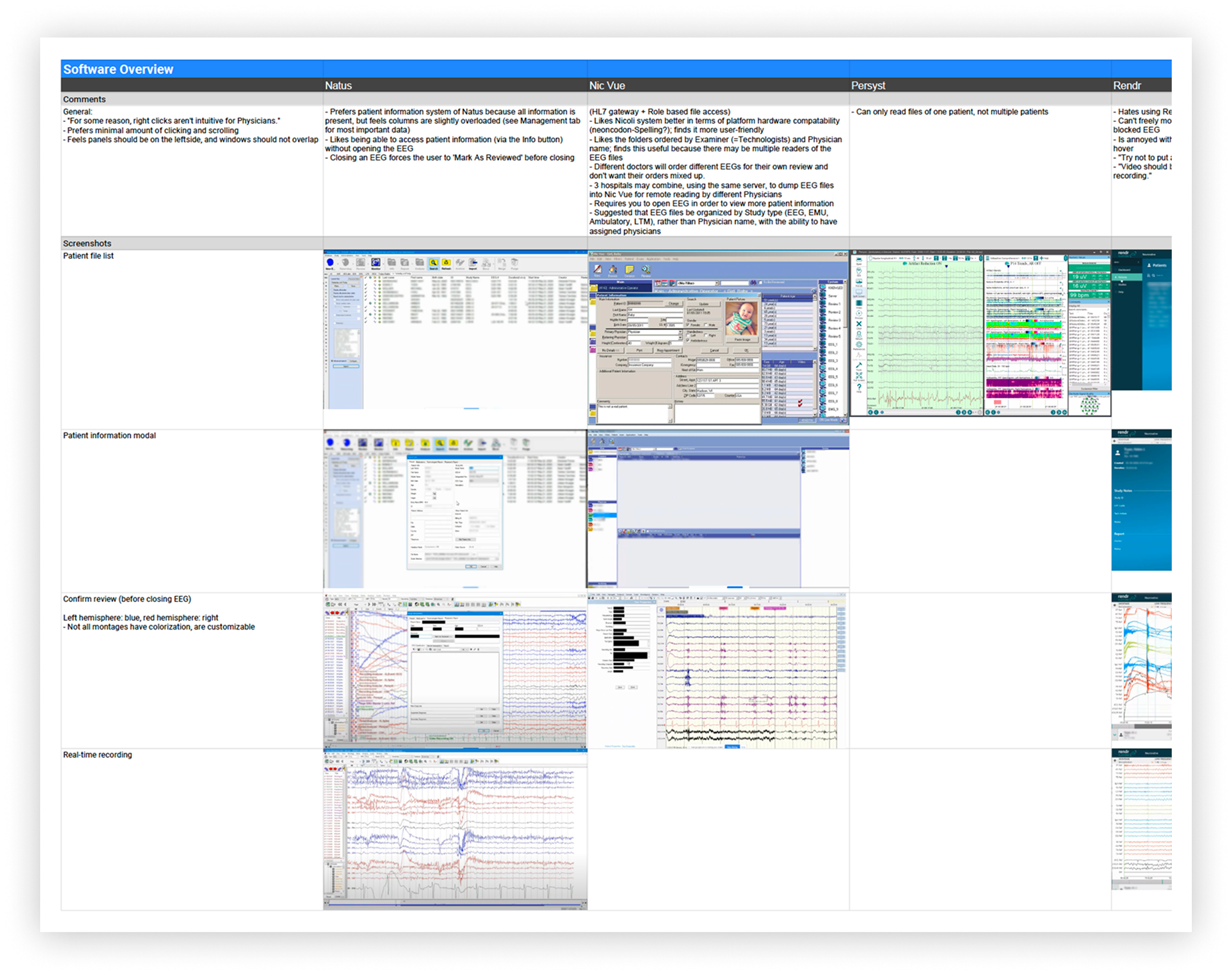
    One of my research outputs included a competitive analysis of existing EEG software solutions.

    Primary Personas


    Establishing a unified understanding of user problems

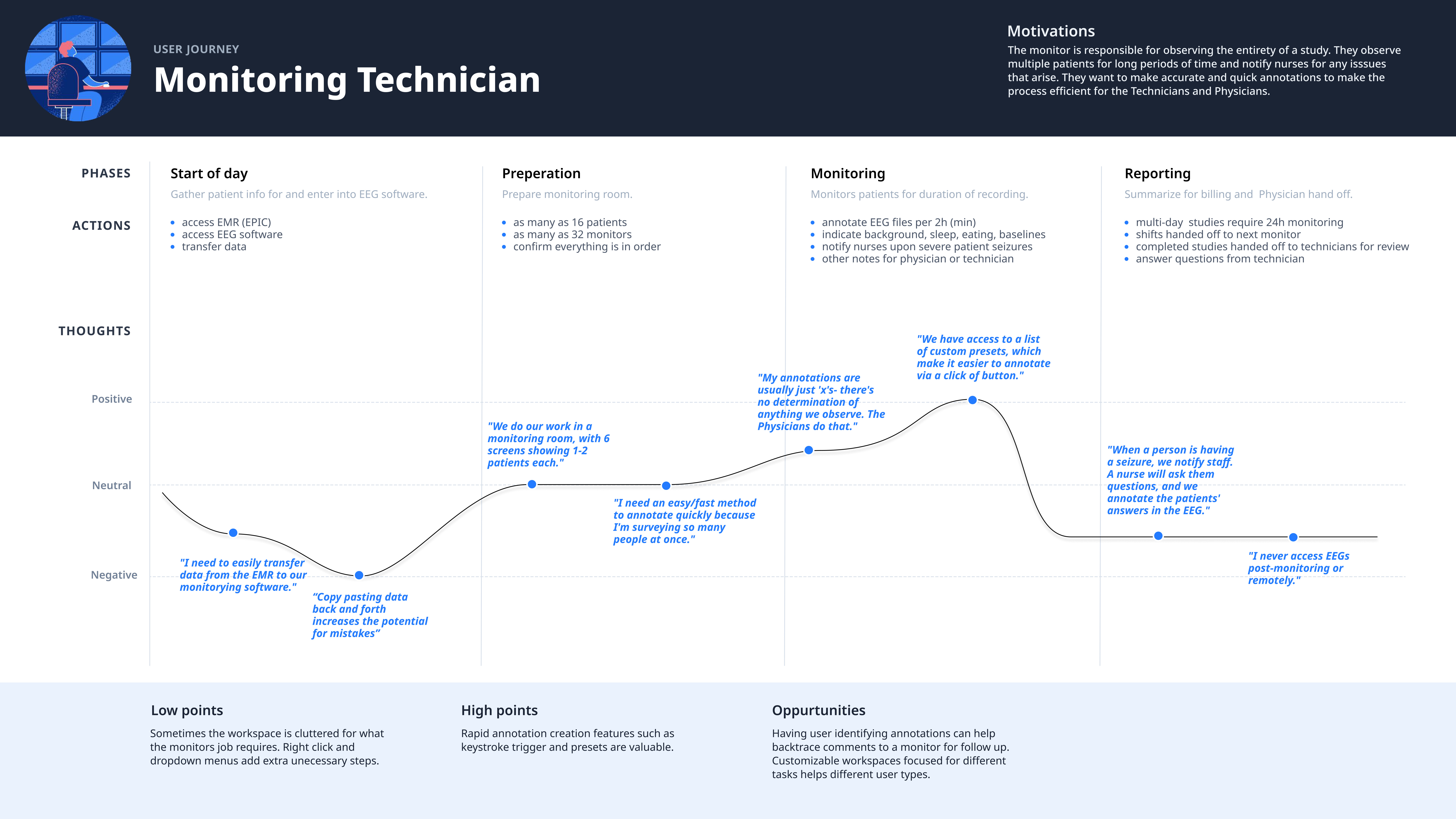
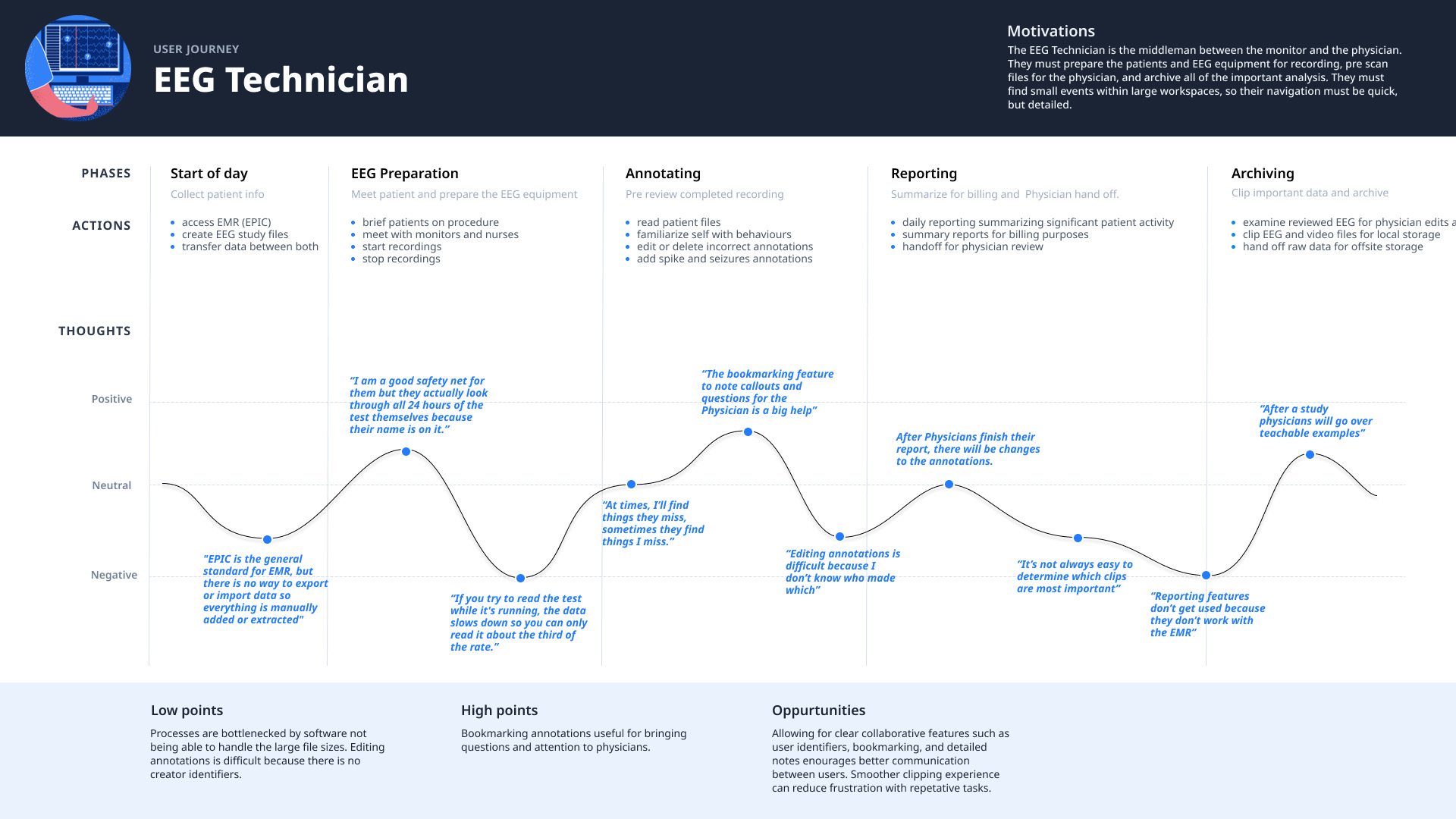
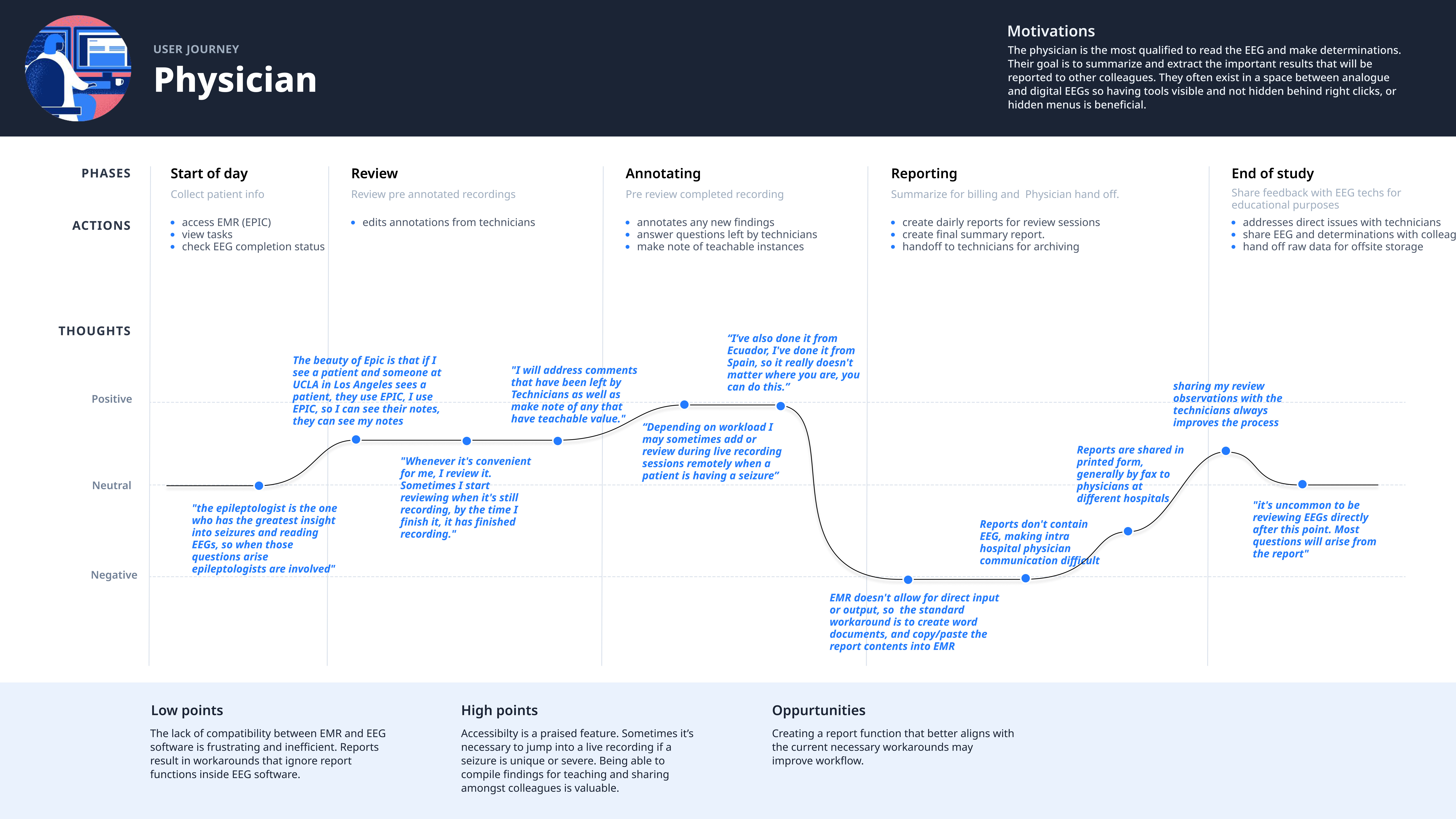
    For MVP, we identified the needs of three user archetypes: Monitor, Technician, and Physician.

    The immersive approach of our research revealed overlapping product opportunities that would resolve common friction points and technical gaps across our primary users' workflows.

    '

    I created quick journey maps to be socialized to our teams based across Gungnam, Korea and California.

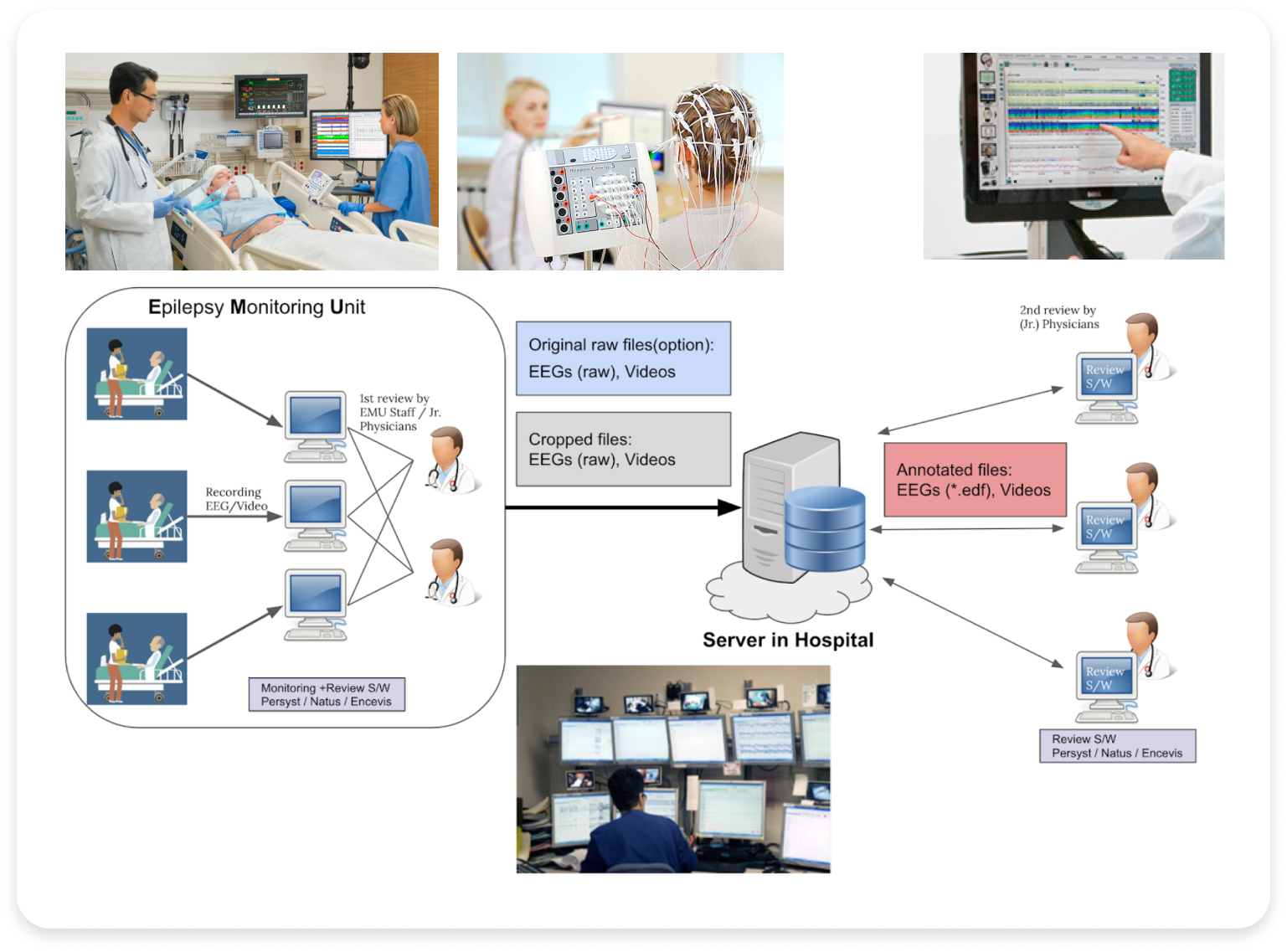
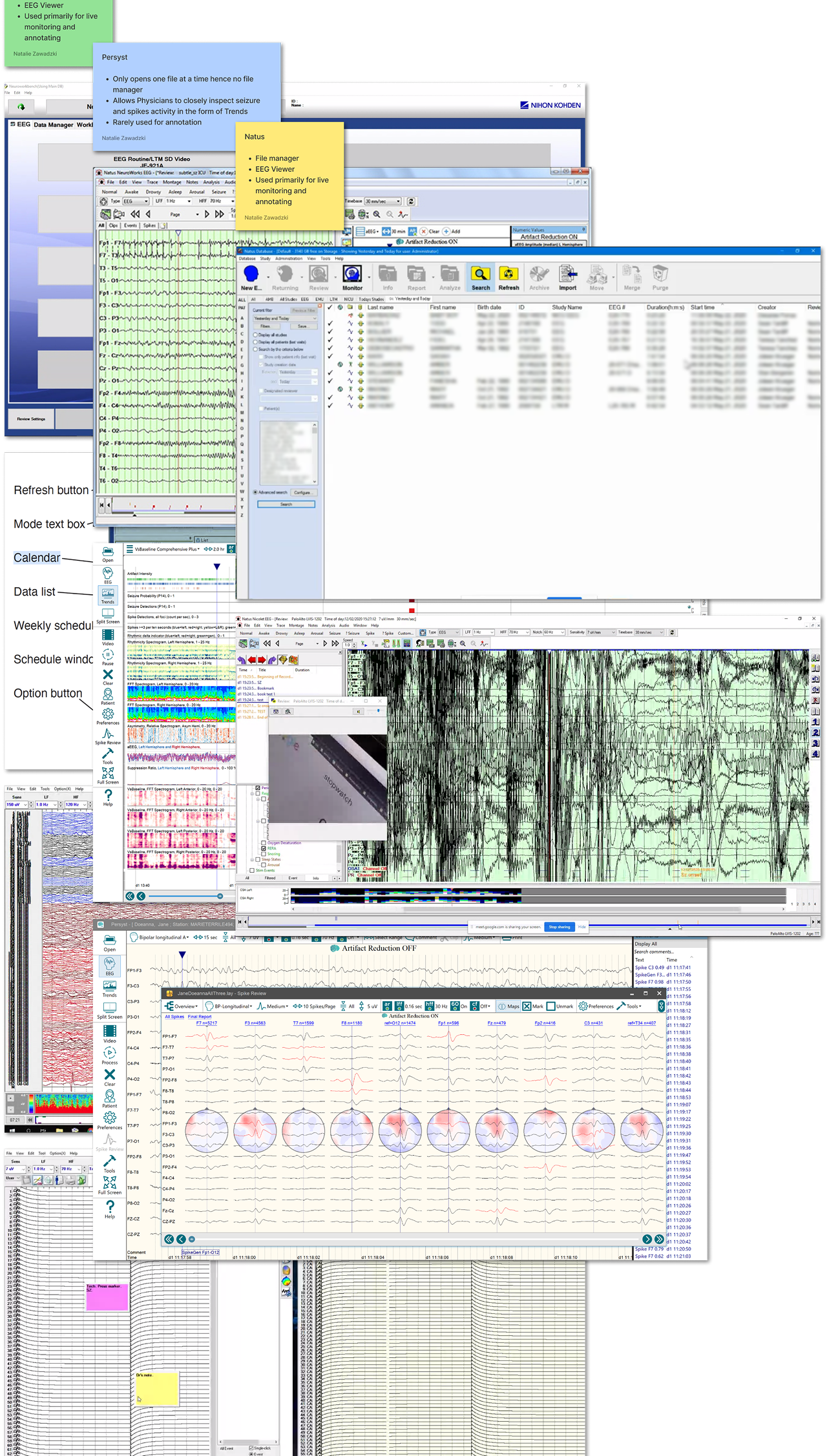
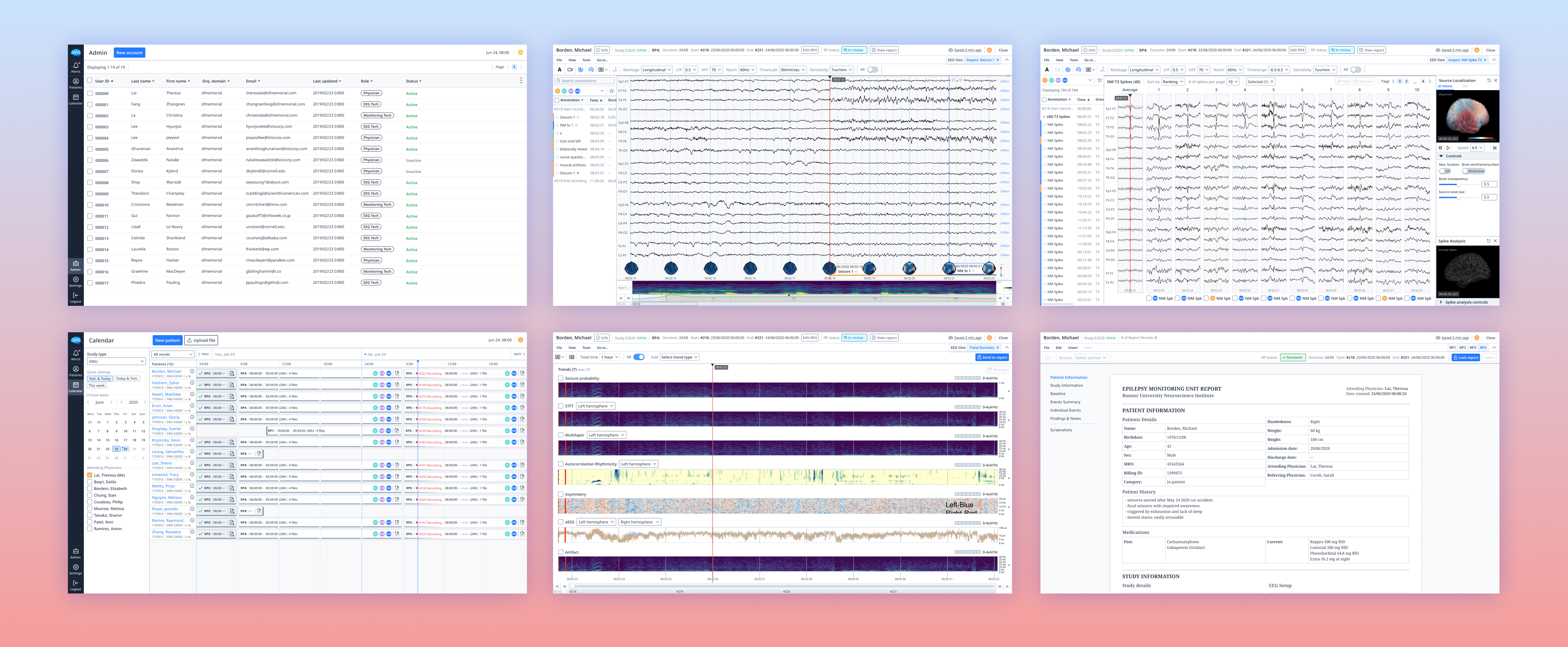
    Compilation of interfaces showing the complexity of tools EEG users navigate

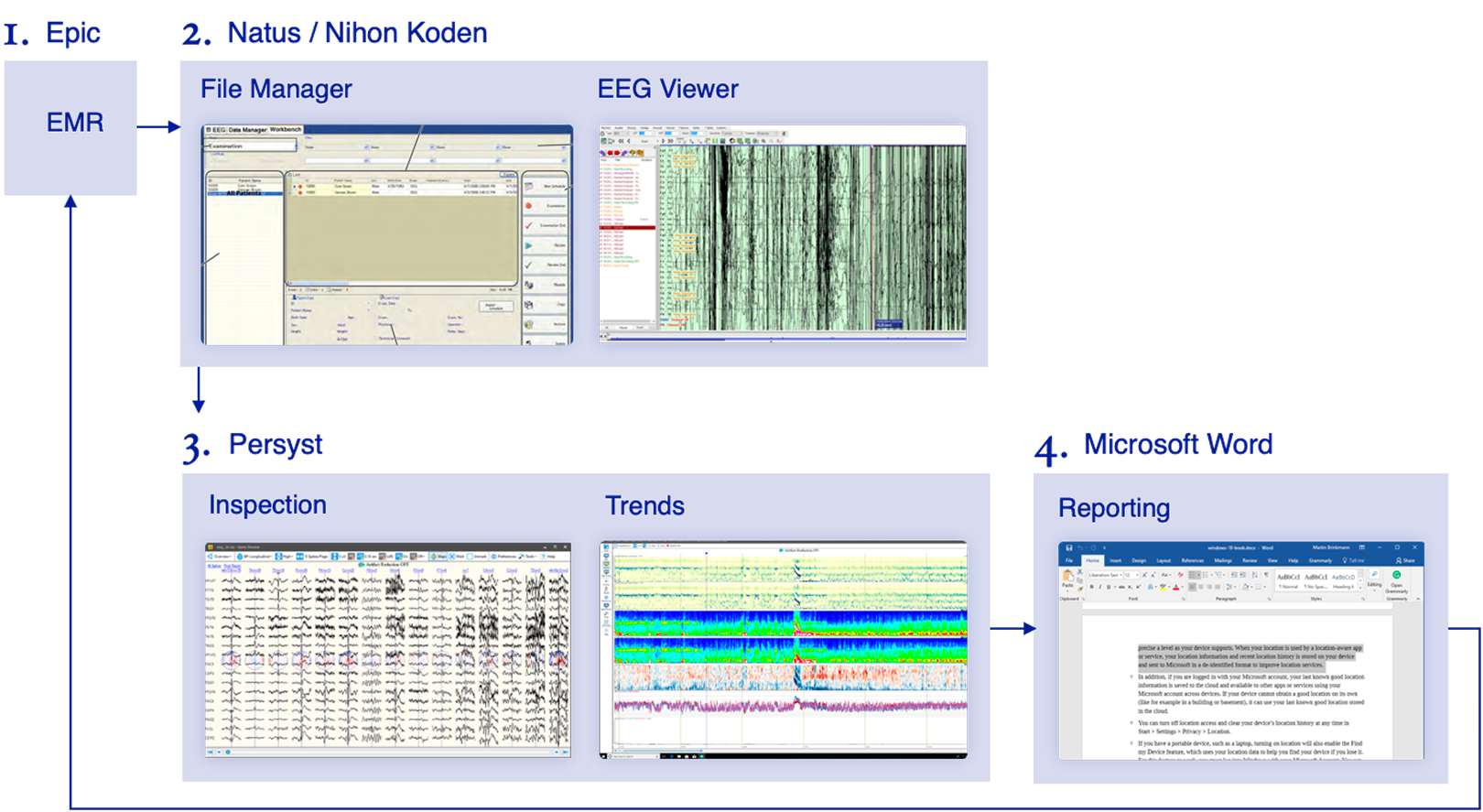
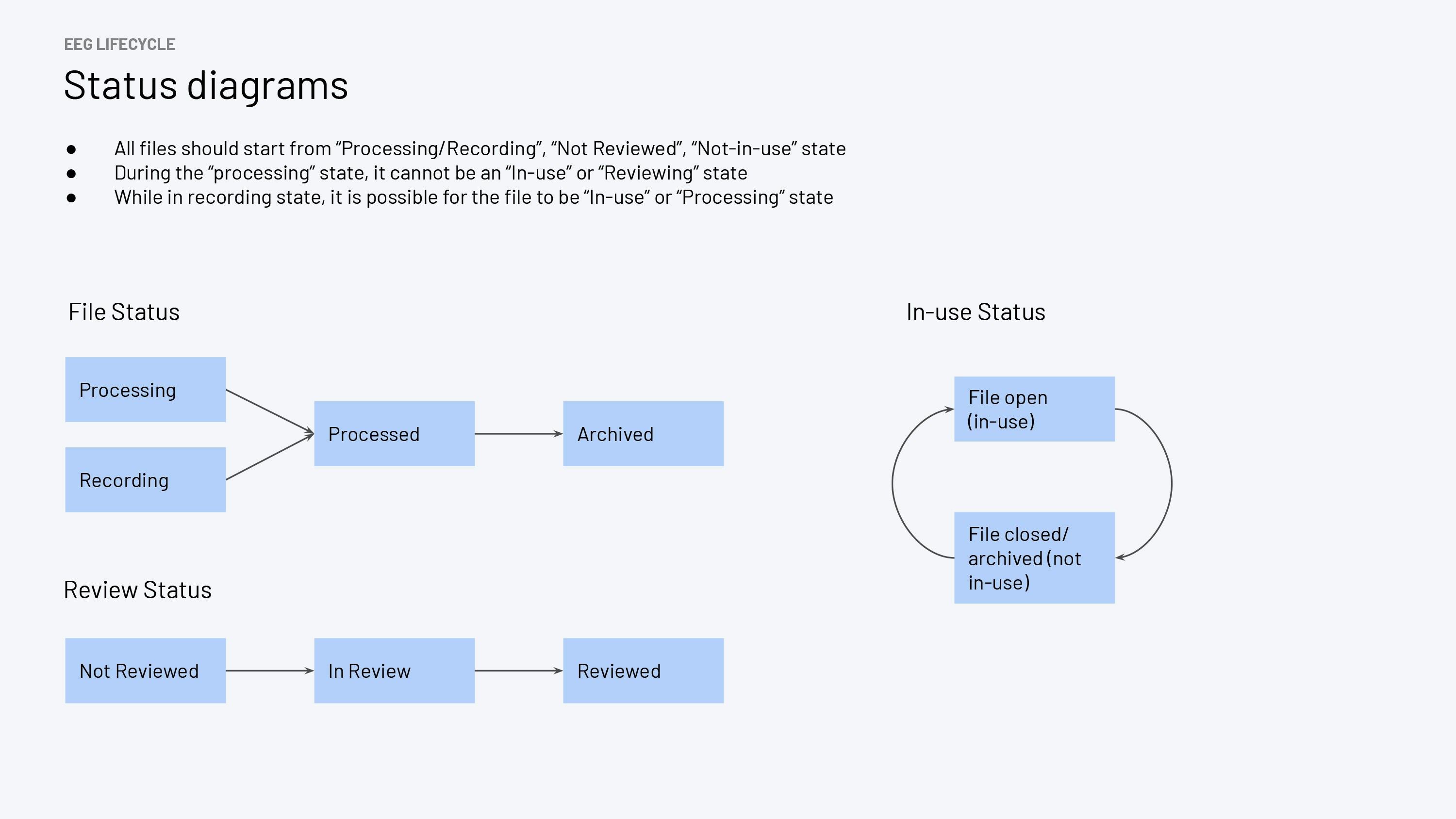
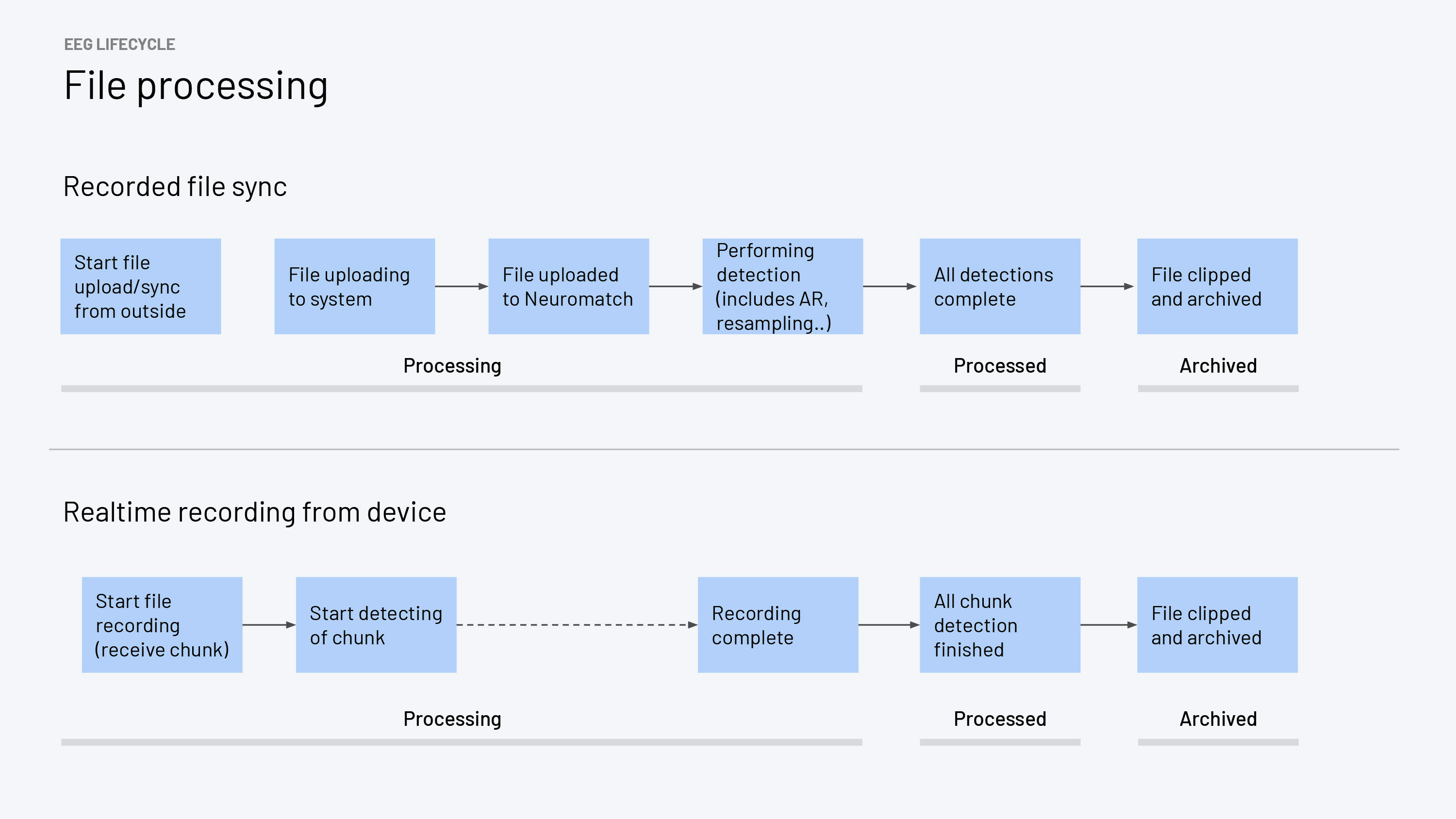
    A simplified diagram that maps main phases of the EEG lifecycle by tool

    Core Problems


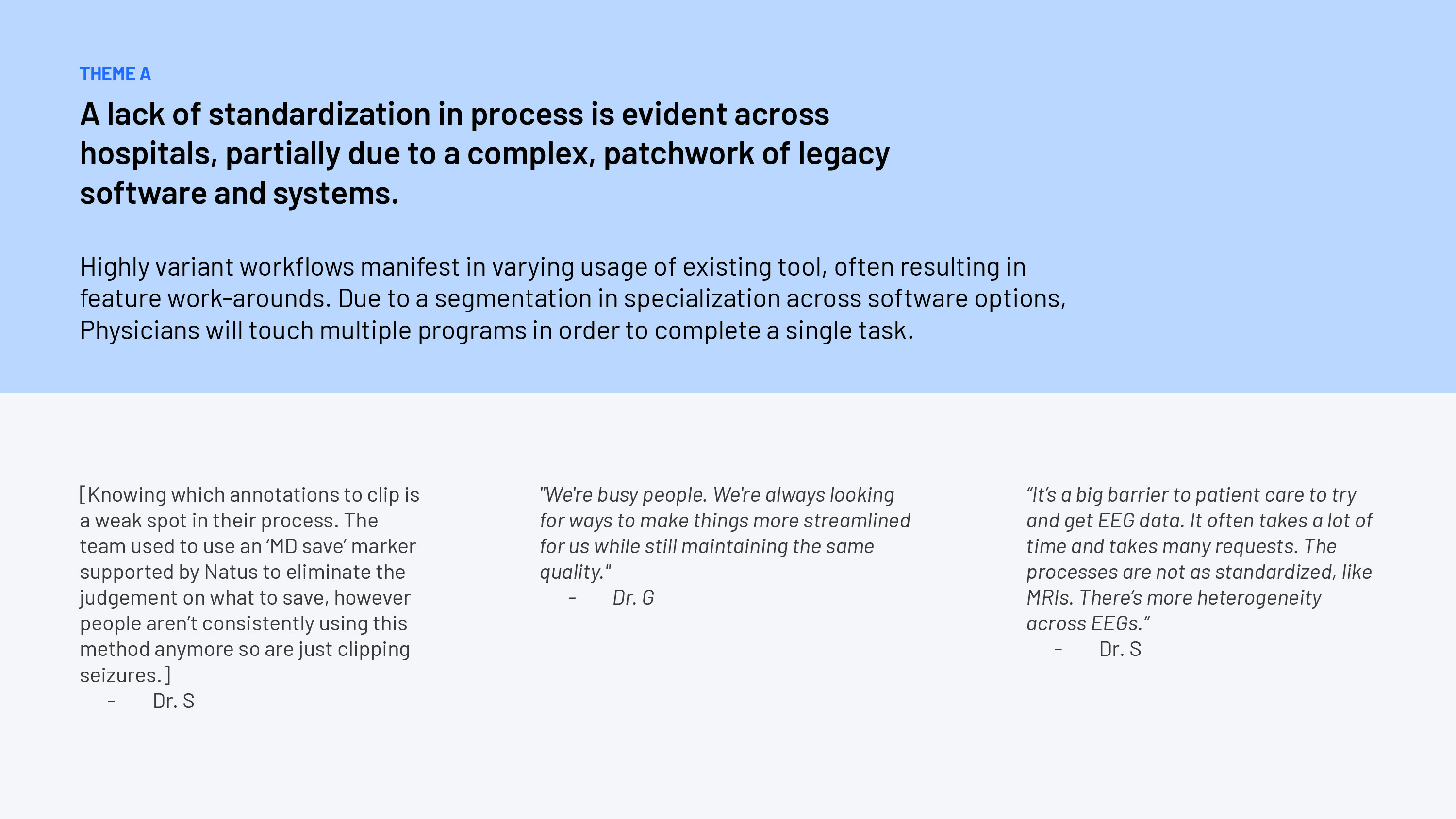
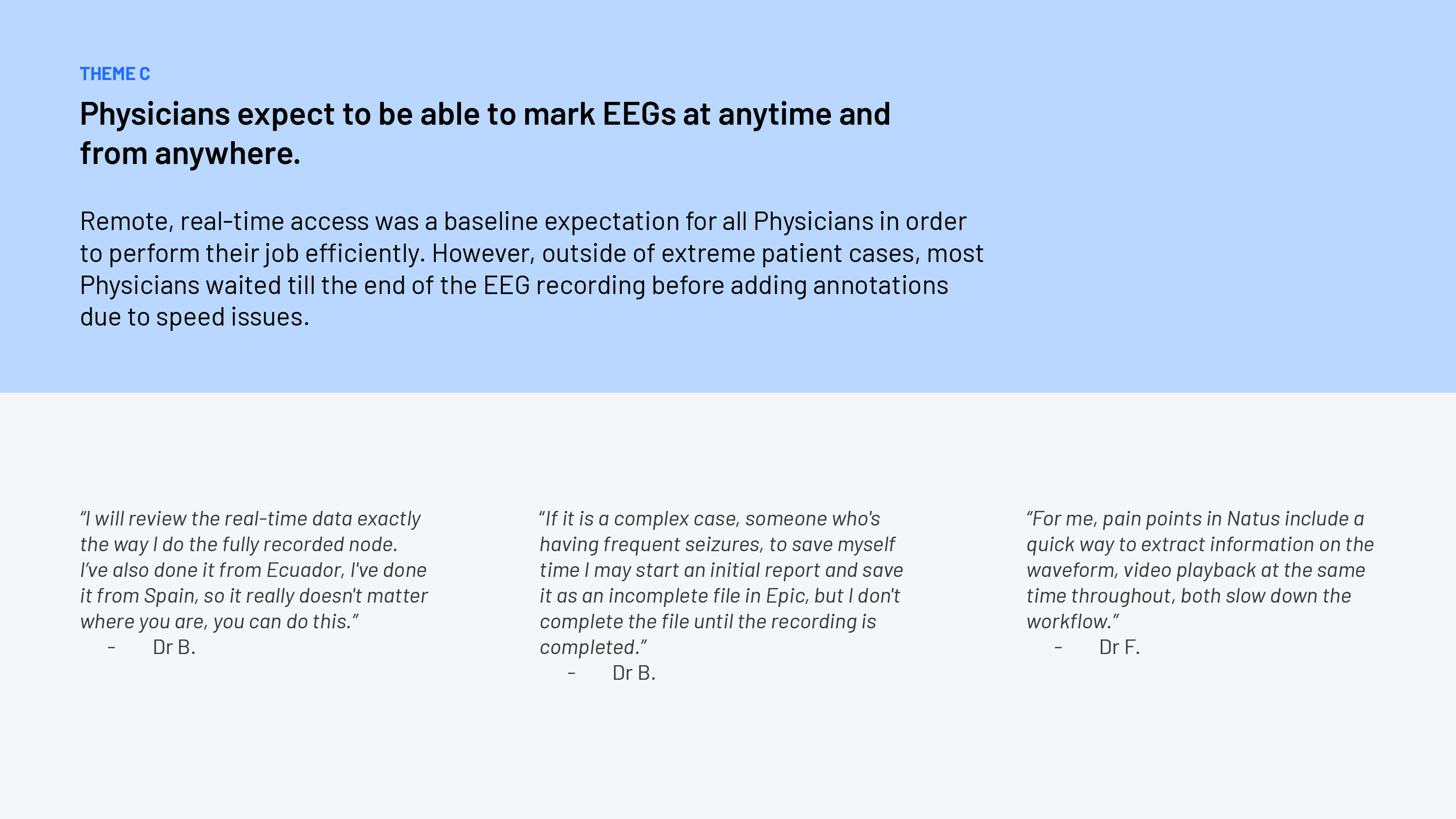
    Physicians navigate a "tool-soup" of products to complete their primary responsibility: EEG analysis

    As a team, we define problems that NeuroMatch would solve into three zoom-levels:

    User-Level Challenges (Micro)

    Daily pain points experienced by physicians
    • Constant context switching between multiple platforms
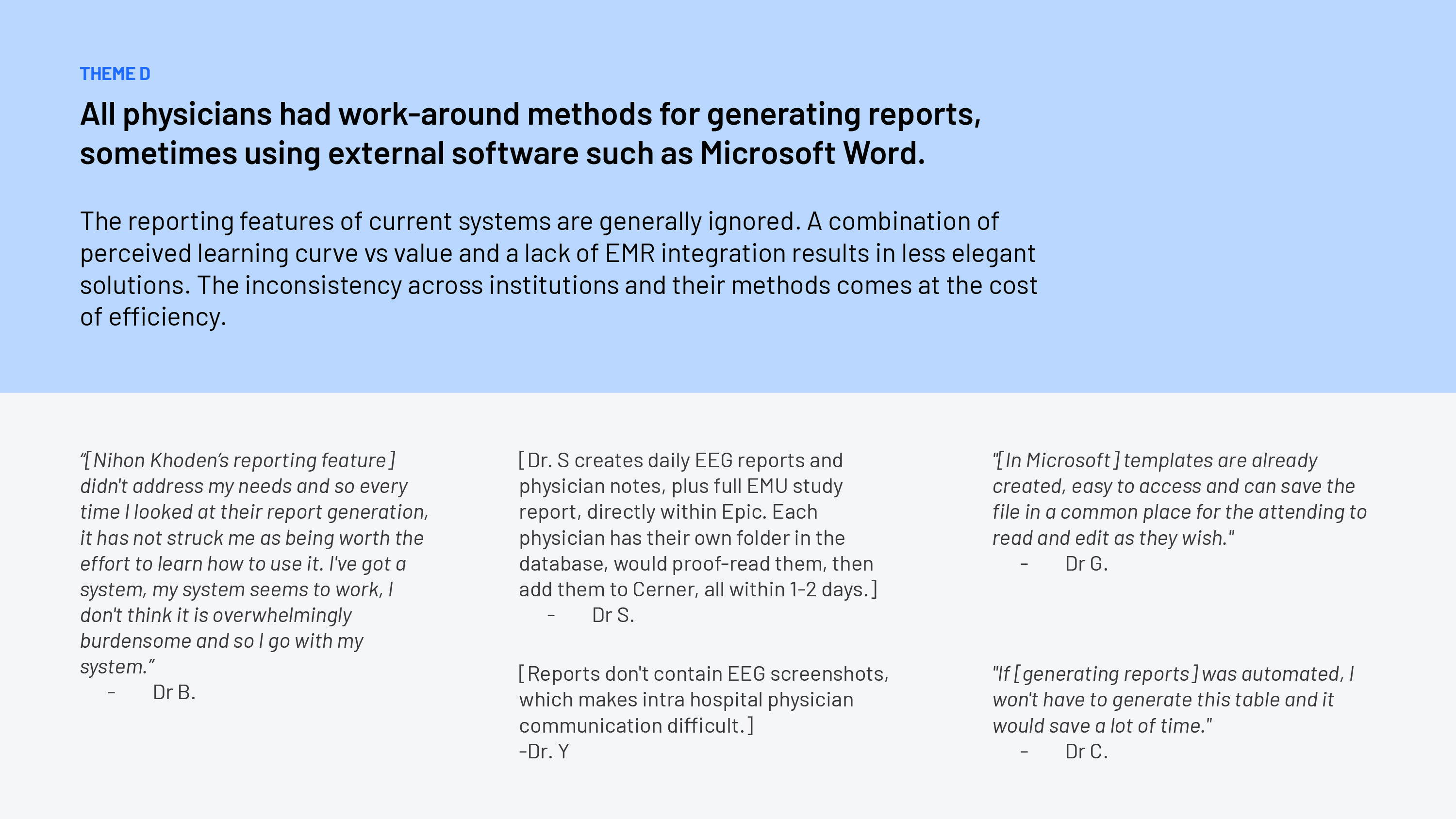
    • High administrative load managing, annotating, and archiving data
    • Lack of parallel workflows for collaborative reporting
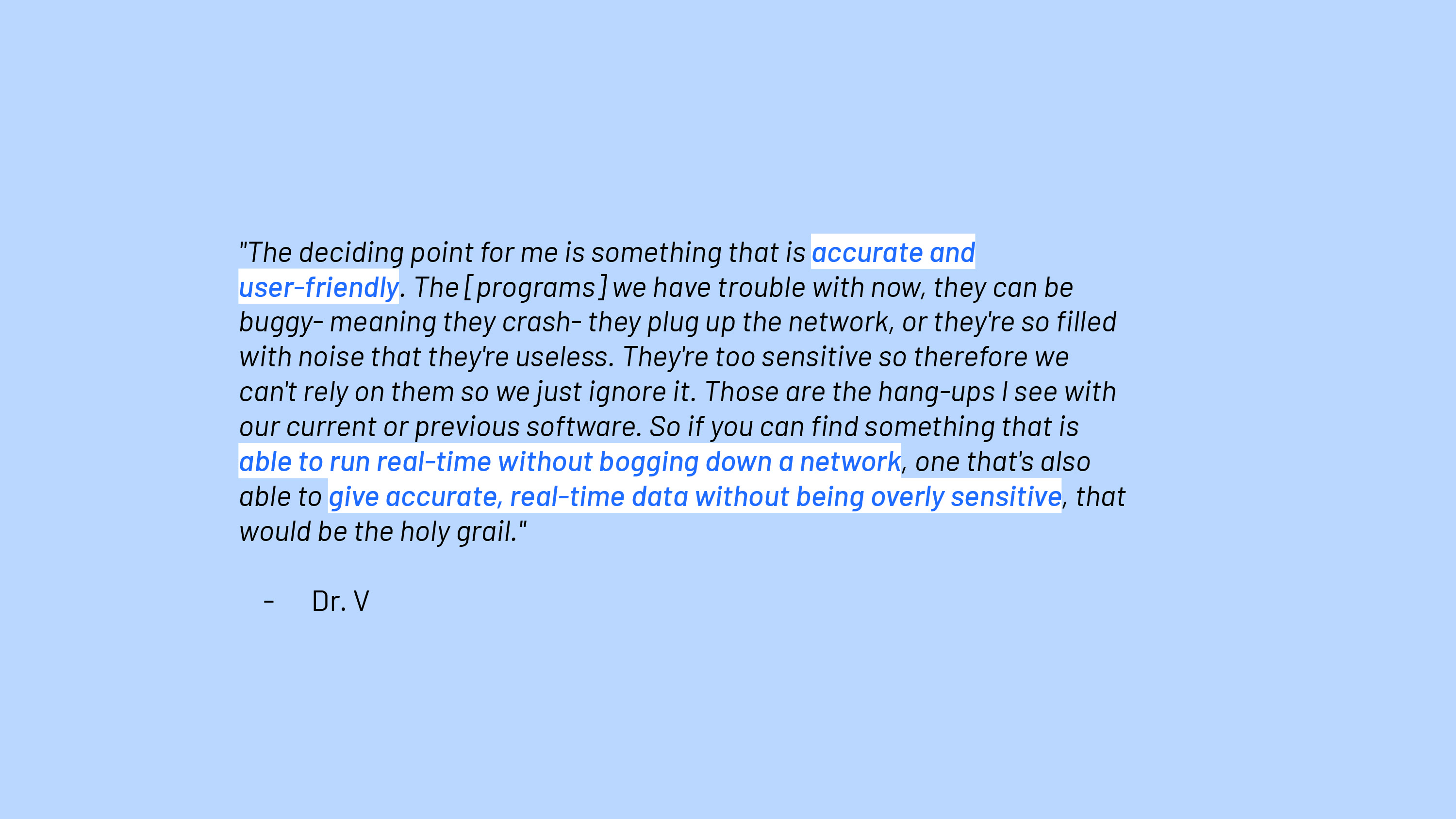
    • Frustration with non-intuitive interfaces and outdated UIs
    • Tracking patient progress over time in a central place

    Organizational & Workflow Challenges (Meso)

    Direct problems within hospital departments and teams
    • Use of separate software for patient records, EEG viewing, analysis, and reporting
    • Proprietary EEG tools from different hardware vendors with outdated UX
    • Custom hospital workarounds that result in inefficient manual workflows

    System-Level Challenges (Macro)

    Wider structural issues in neurology + healthcare
    • Delayed diagnoses due to lack of biomarker-based precision
    • FDA compliance hurdles preventing modern software/hardware updates
    • High cognitive burden from multi-system workflows
    Planning

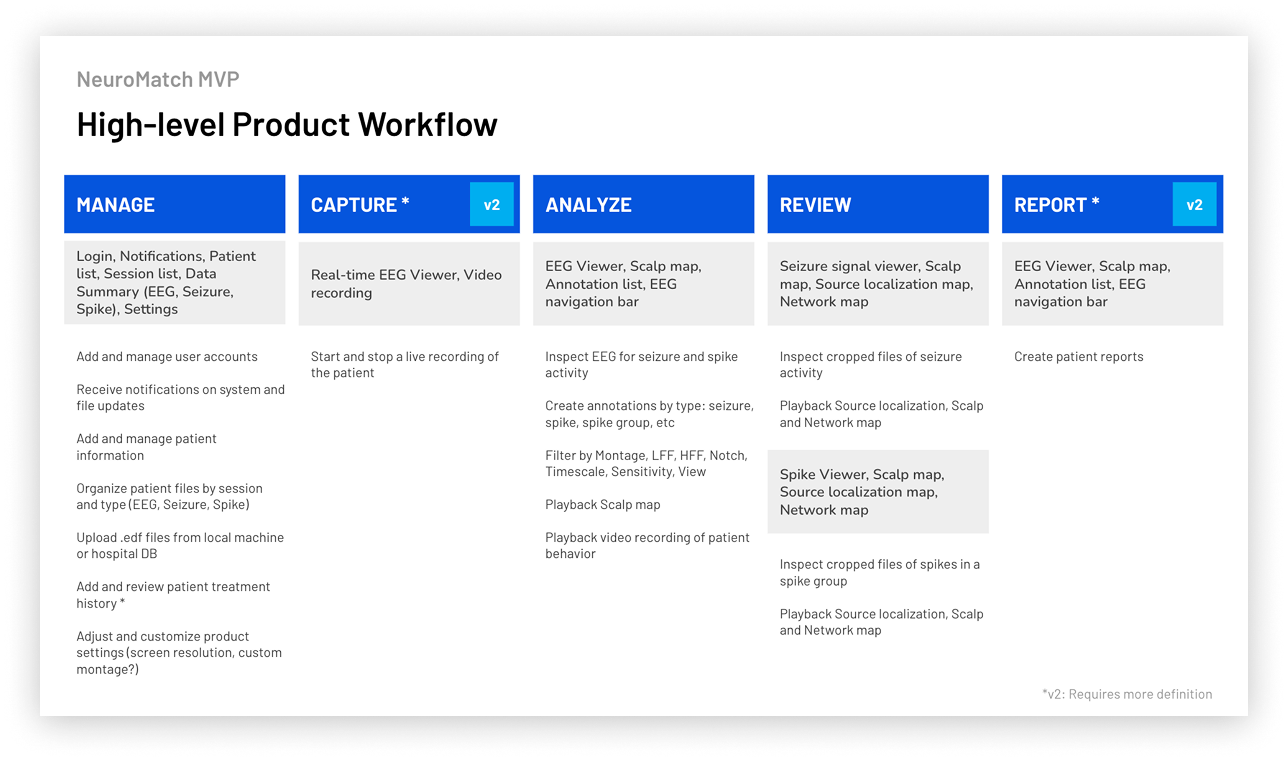
    For bi-monthly presentation updates to our Founder, I collaborated with my triad leads to visualize a high-level map of the most crucial areas we would address in the launch of Neuromatch V1/MVP.

    Scaling and standardizing processes for faster, frictionless handoffs to Engineering
    Figma Design System

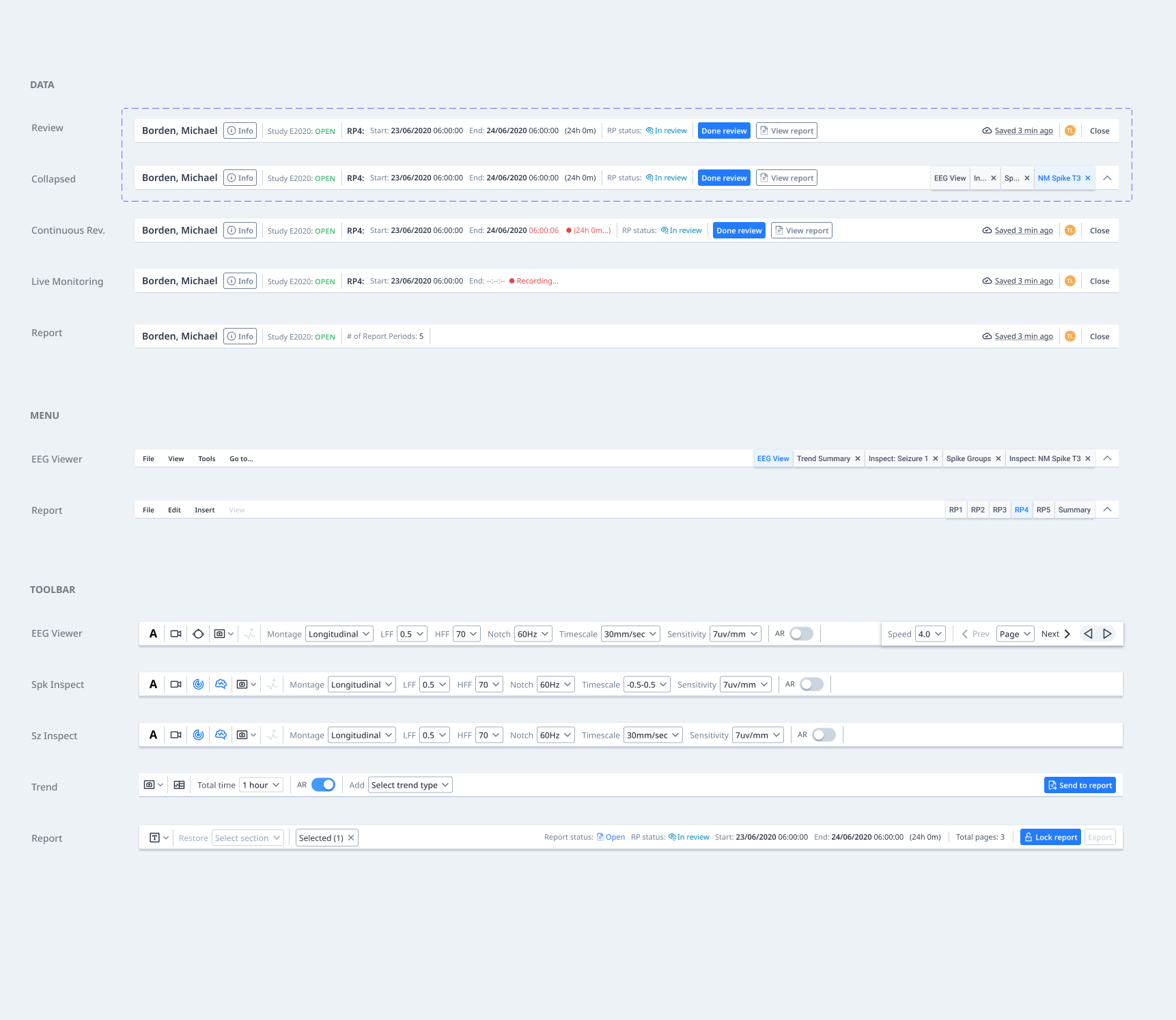
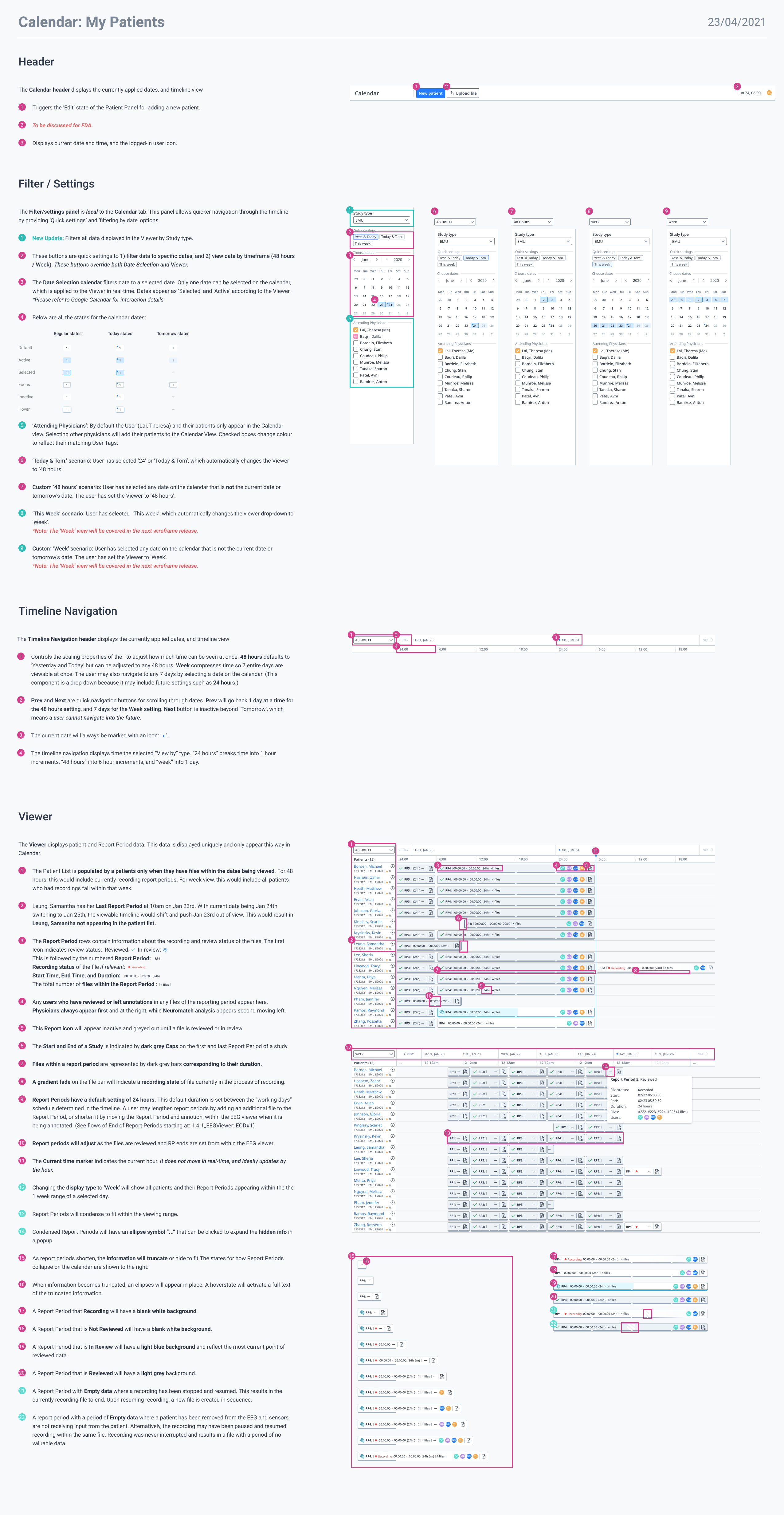
    Starting with accessibility and clinical usability as core principles, I developed a scalable component library, clear interaction patterns, key EEG scenarios, and documentation tailored to cross-functional collaboration.

    The system brought consistency across our suite of core tasks in Neuromatch, accelerating development velocity while modernizing the standards of existing healthcare software.

    Sprints, Jira, & Hand-offs

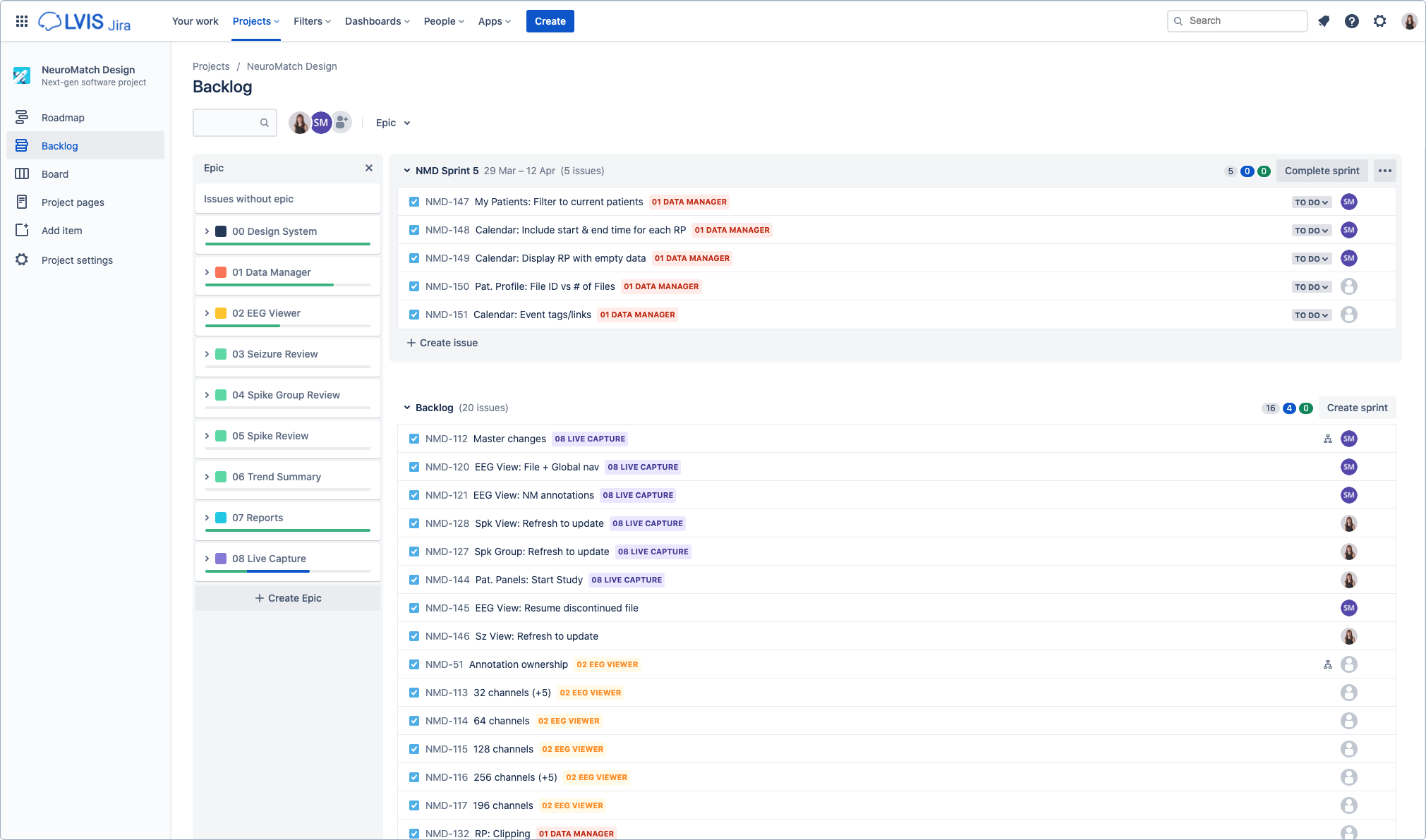
    To support a focused and efficient MVP launch, I created Jira epics mapped to core product areas, aligning design efforts with high-impact user flows such as onboarding, diagnostics, and reporting. Each epic included well-defined stories that captured design tasks, user research inputs, and key collaboration checkpoints.

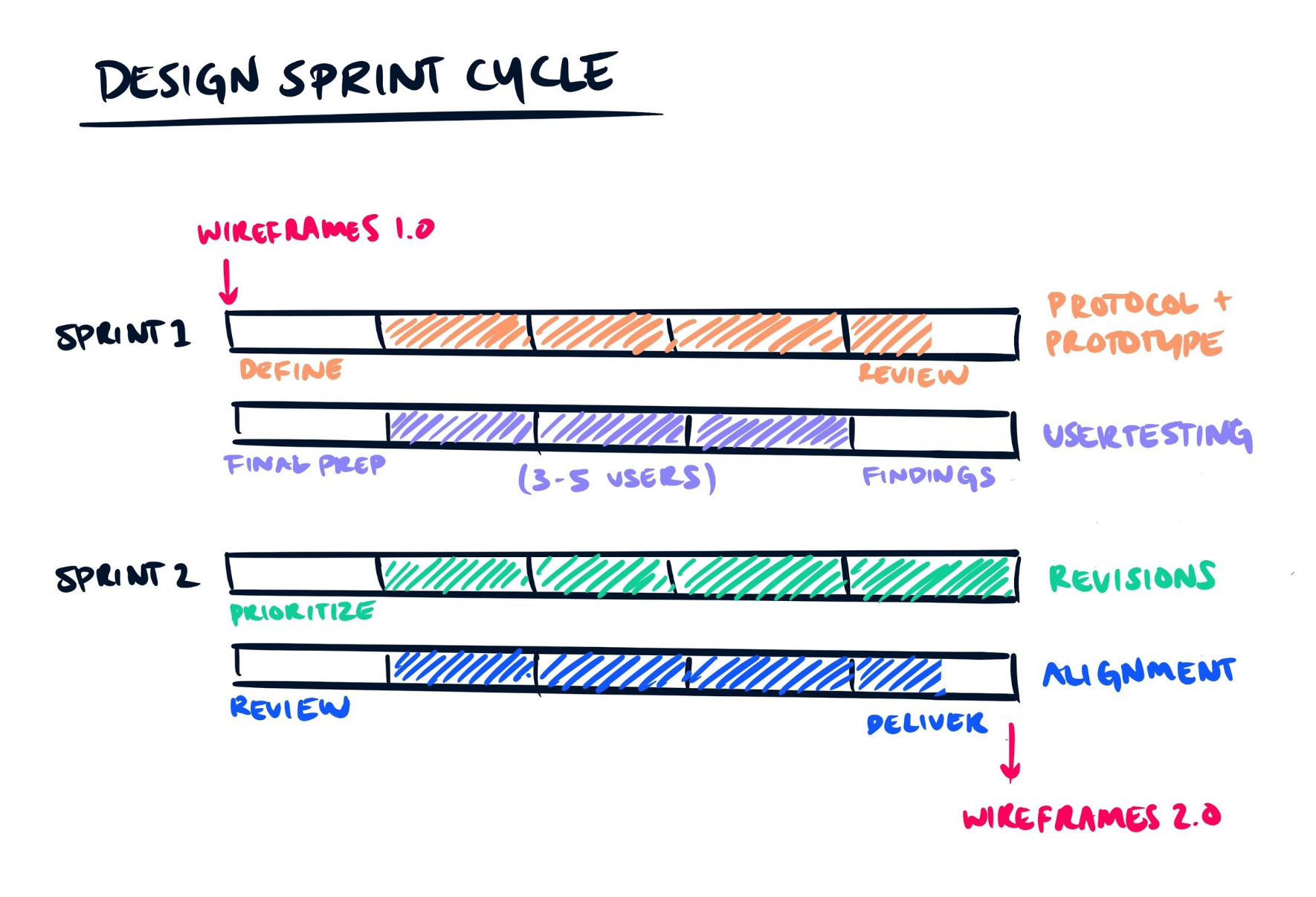
    I also established Agile best practices with bi-weekly sprints, fostering rapid iteration, clear accountability, and tight alignment with product and engineering. This structure ensured every design deliverable directly supported MVP goals while driving team efficiency and cross-functional cohesion.

    User testing


    Iterative cross-functional brainstorming & User feedback cycles

    Product adoption hinged on FDA approval and depended heavily on passing rigorous user testing with end users. Preparing for this level of scrutiny to regulatory expectations meant regular usability testing was crucial. Our iterative approach ensured we captured the right insights early and often, thus minimizing surprises that could risk our FDA deadline.

    Within three months of joining LVIS, my team was iteratively building towards NeuroMatch v2 based on the user-centered processes I established, which incorporated weekly cross-functional brainstorms and regular user interviews.

    Our Design, Product, and Clinical Research departments partnered closely in bi-weeekly sprint cycles to gather focused feedback across critical product areas, ensuring each iteration directly contributed to FDA readiness and a validated user experience:

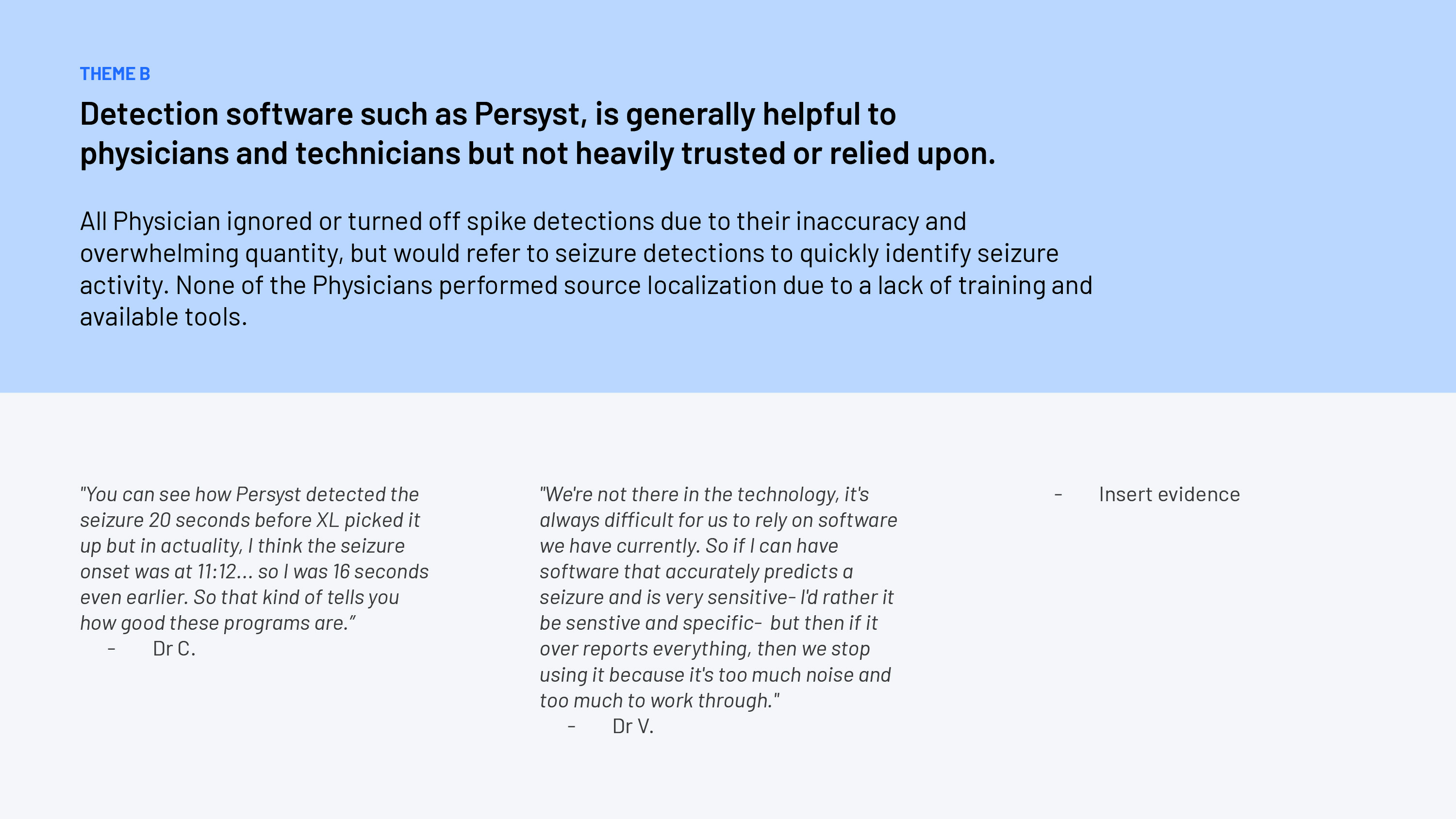
  • Accuracy of machine-learning seizure detection.
  • Visualization and rendering of brain models
  • Seizure annotation preferences on EEGs
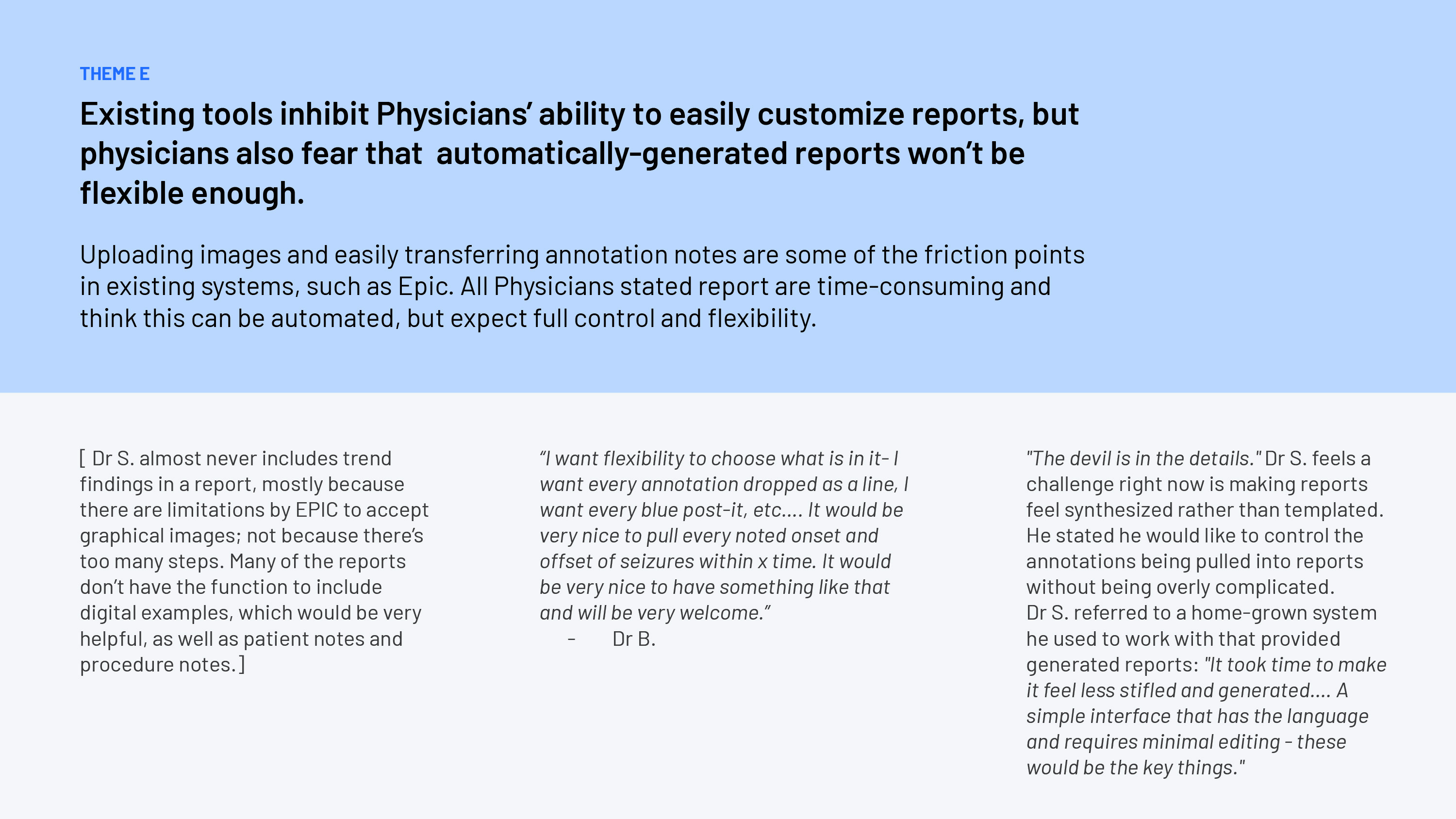
  • Patient reporting preferences
  • Trend reports
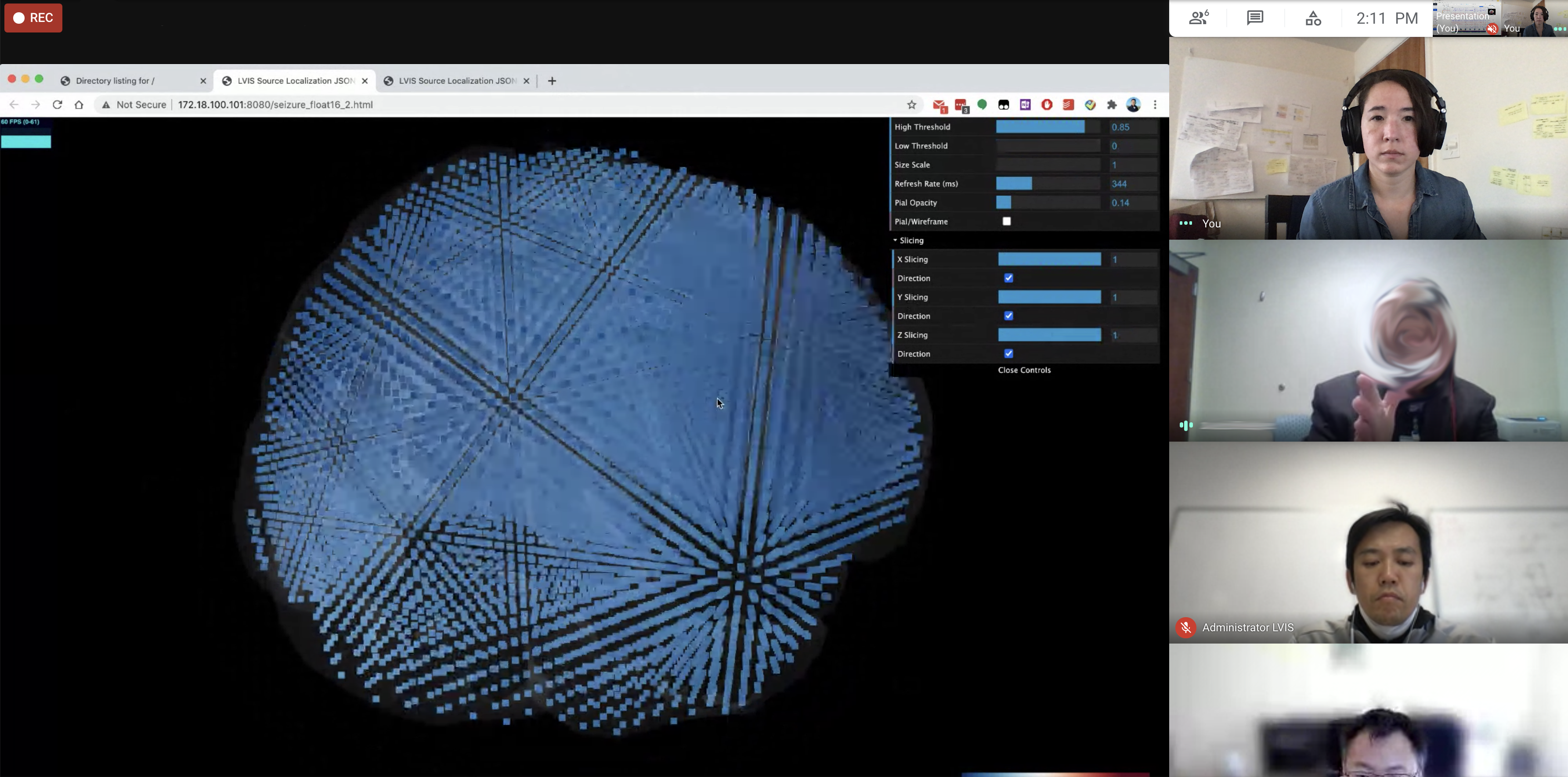
  • One of my many interviews with Physicians collecting feedback on the value of our ML-powered seizure visualization models.

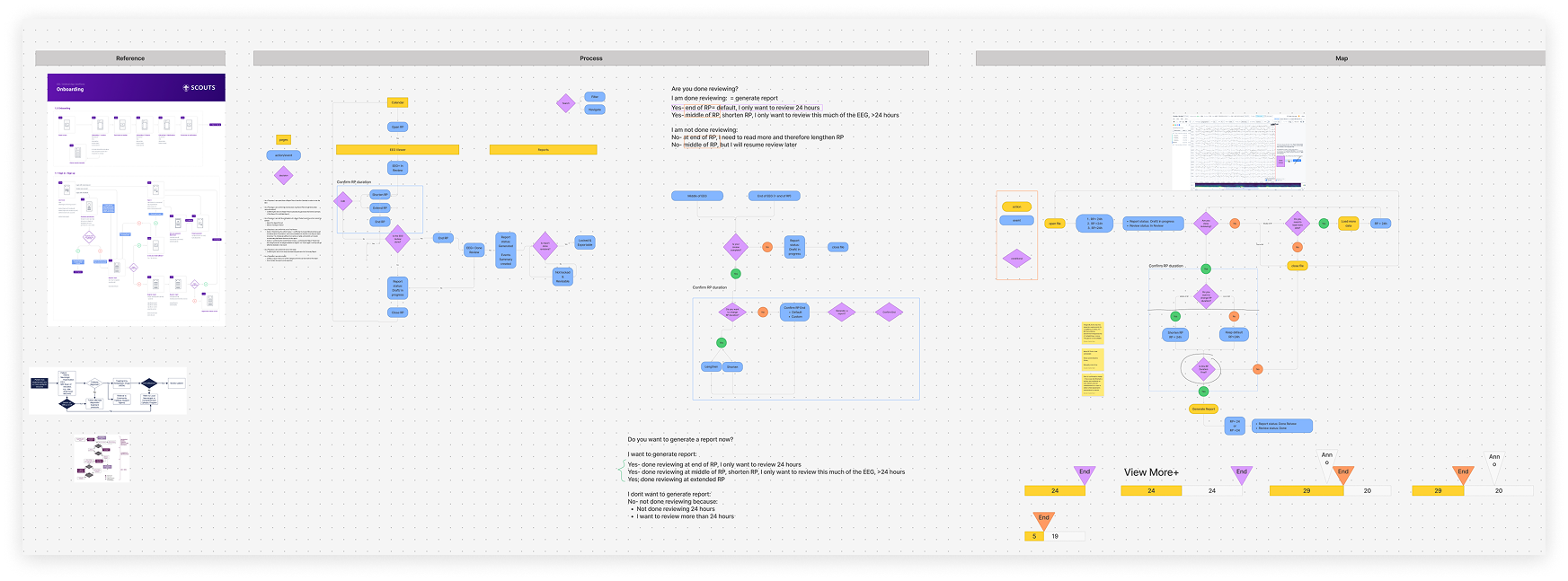
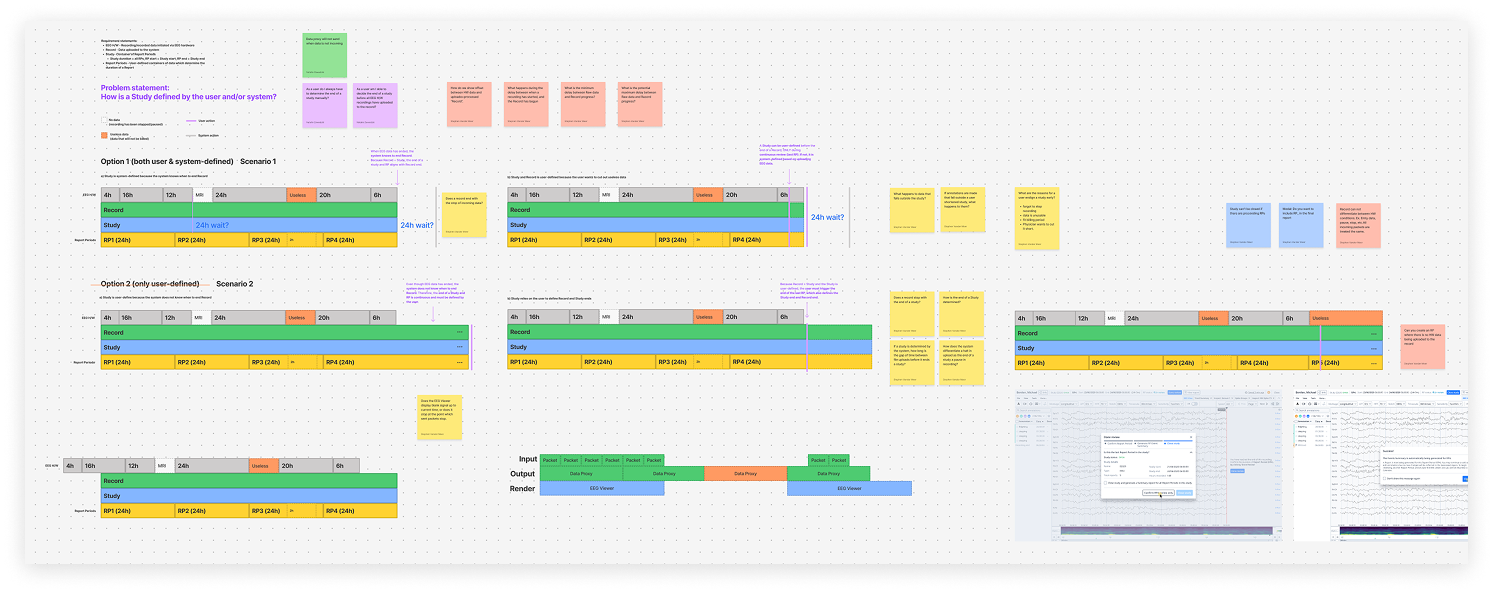
    A series of Figjams that brainstormed improving the speed of real-time data intake, machine-learning analyses, and playback within browsers.

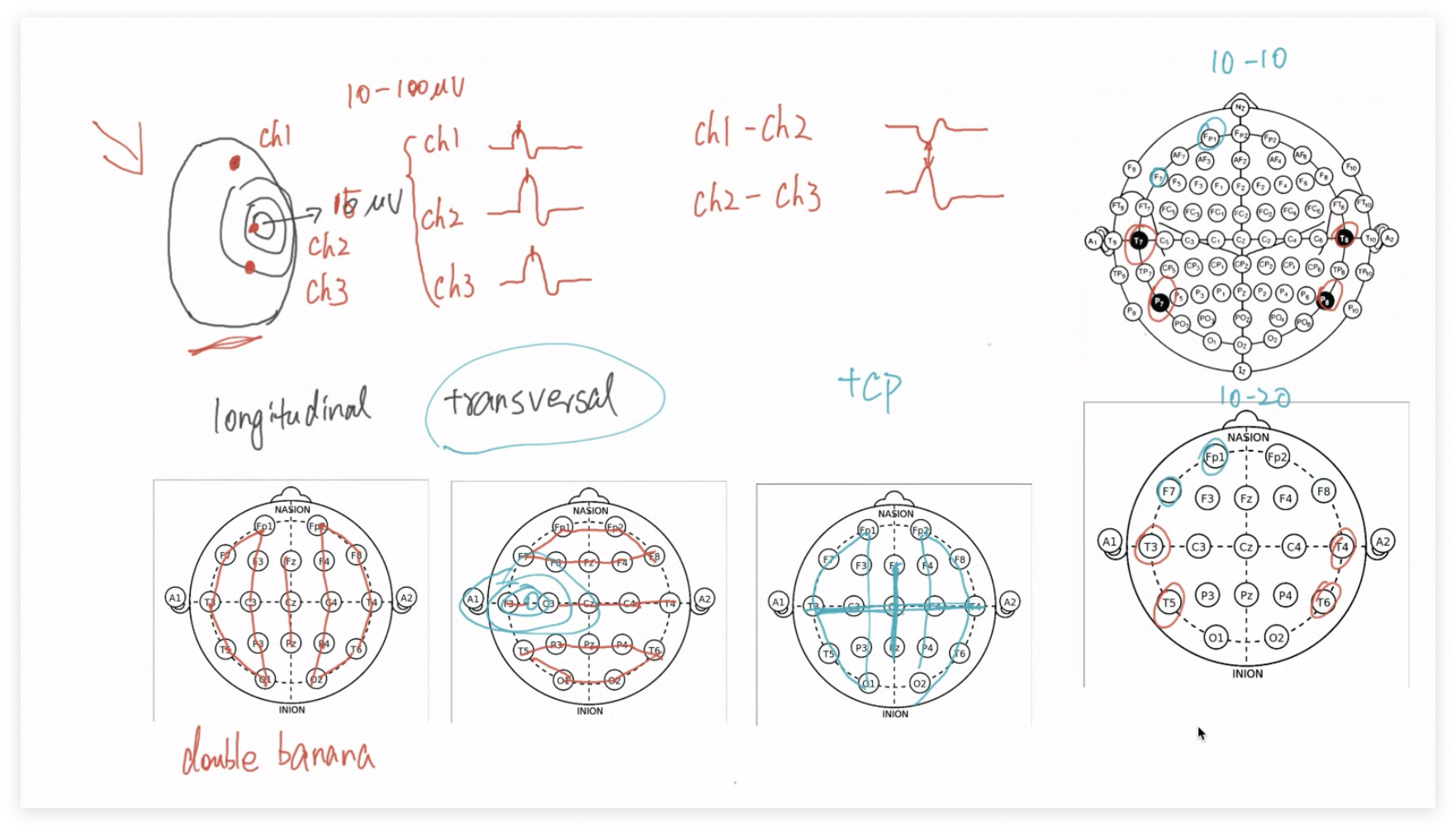
    Internal education materials on seizure fundamentals that were imperative to decision-making.

    Outcomes


    Successful FDA approval and product launch

    By paving the road on user research, connecting feedback to product strategy, establishing design-to-development processes, etc, my contributions to the LVIS team and full design of NeuroMatch v2 ensured FDA approval and successful launch of NeuroMatch for adoption.

    For more work samples or a quick chat, get in touch.